
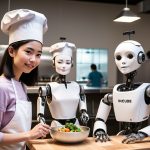

Description
The fourth industrial revolution, also known as Industry 4.0, brings together technologies like robotics, artificial intelligence (AI), virtual reality (VR), and the Internet of Things (IoT) to revolutionize various sectors, including food services and culinary arts. Integrating these advancements into culinary education can empower students with modern tools, helping them become more efficient, innovative, and tech-savvy professionals. These technologies not only enhance practical skills but also streamline learning processes and introduce new creative possibilities in the kitchen.
Keeping the Kitchen Organized
Virtual reality can serve as a valuable tool to teach students how to maintain kitchen equipment, organize tools, and manage inventory effectively. Through VR training, they can simulate real-world scenarios to prepare their workstations, operate machinery, and ensure that hygiene and safety standards are met. This immersive experience allows learners to grasp the correct workflow, even without direct access to physical kitchen equipment.
Preparing Ingredients with Precision
Robotics and AI systems simplify the handling and processing of raw ingredients, allowing students to master tasks like portioning and calculating precise quantities through advanced algorithms and virtual tools. These technologies promote efficiency and minimize food waste, while VR can simulate the process of selecting and preparing ingredients in a highly interactive and realistic way.
Cooking and Presenting Dishes
Robotics can take on specific cooking tasks, while AI assists in automating processes like soup, sauce, and main dish preparation. By harnessing these technologies, students can regulate ingredient quantities more accurately, streamline the cooking process, and maintain consistently high-quality results. VR simulations also allow students to practice dish presentation, providing a visual and aesthetic evaluation of their creations in real time.
Creating Desserts
Automated equipment can help students achieve perfect temperature control and create optimal conditions for dessert preparation. Virtual simulations offer hands-on training in advanced dessert techniques, such as decoration and quality control. These simulations also allow students to experiment with various presentation styles and methods in a risk-free environment.
Event Catering and Large-Scale Cooking
Robotic and AI-driven systems are particularly useful when preparing food for large events or banquets, ensuring both production efficiency and quality management. VR can simulate banquet service, providing a realistic training environment where students can practice organizing events, work in teams, and learn how to serve food in an aesthetically pleasing way.
Managing Food Safety and Documentation
IoT and AI technologies can automate the monitoring of ingredient quantities, track hygiene logs, and streamline food safety documentation. Virtual platforms provide an opportunity for students to learn proper labeling and inventory management, ensuring adherence to food safety regulations and protocols.
Developing Healthy Recipes
AI and IoT also support the creation of health-conscious recipes by helping select ingredients that meet modern dietary trends. Robotic systems assist in preparing food with accurate nutritional analysis, ensuring the nutritional quality of the meals produced.
By adopting Industry 4.0 technologies in culinary education, students gain a significant advantage in preparing for today’s rapidly evolving food industry. These technologies allow future chefs to work more efficiently, maintain high-quality standards, and explore new creative avenues in their culinary careers. Through a combination of practical automation and immersive simulations, students can elevate both their technical abilities and their artistic flair in the kitchen.
